What Is Pulmonary Alveolar Proteinosis?
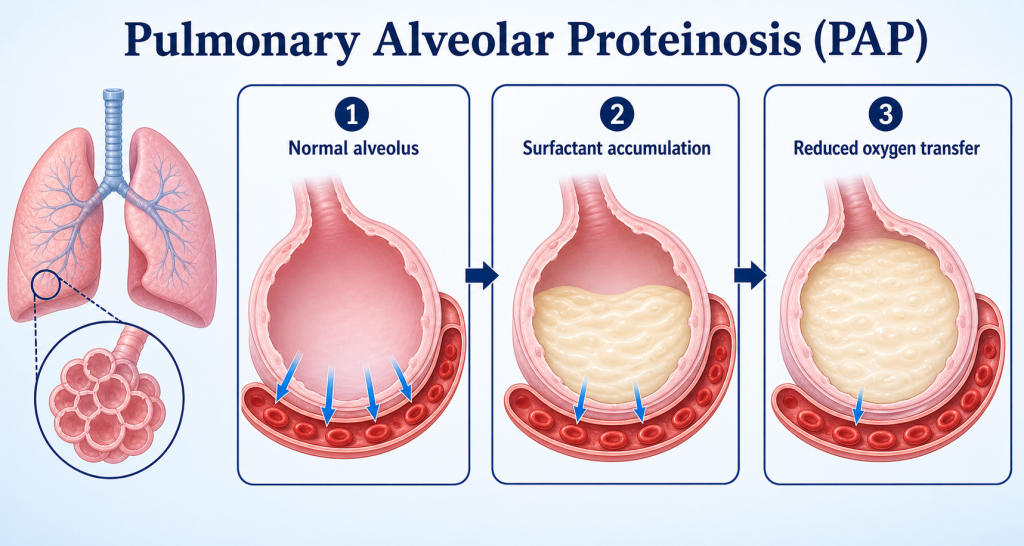
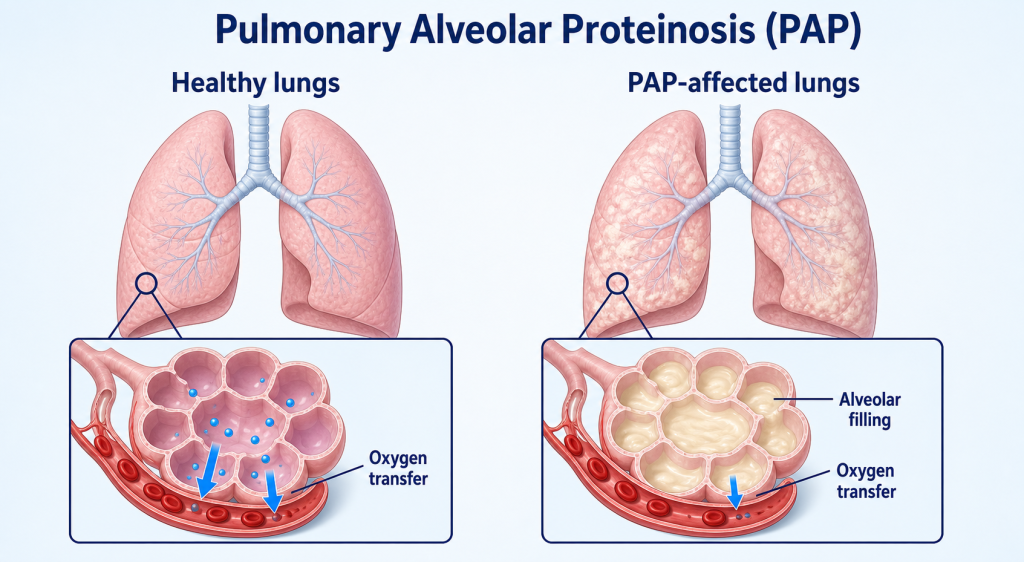
Pulmonary Alveolar Proteinosis (PAP) is a rare lung disorder characterized by the accumulation of surfactant—a lipoprotein substance—within the alveoli (air sacs) of the lungs. This buildup impairs gas exchange, leading to reduced oxygen levels in the blood and respiratory difficulties. The condition arises due to impaired clearance of surfactant by alveolar macrophages rather than overproduction.
What Causes Pulmonary Alveolar Proteinosis?
PAP can be classified into three main types based on its underlying cause:
- Autoimmune PAP: The most common form, accounting for approximately 90% of adult cases. It results from the presence of autoantibodies against granulocyte-macrophage colony-stimulating factor (GM-CSF), a protein essential for the maturation and function of alveolar macrophages responsible for surfactant clearance.
- Secondary PAP: Occurs due to underlying conditions that impair alveolar macrophage function, such as hematologic malignancies (e.g., leukemia), inhalation of environmental toxins (e.g., silica, titanium), or certain infections.
- Congenital PAP: A rare form caused by genetic mutations affecting surfactant production or clearance, typically presenting in neonates and infants.
What Are the Symptoms of Pulmonary Alveolar Proteinosis?
Symptoms of PAP can vary depending on the severity of surfactant accumulation:
- Common Symptoms:
- Progressive shortness of breath (dyspnea)
- Chronic dry or productive cough
- Fatigue and malaise
- Unintended weight loss
- Low-grade fever
- Clubbing of fingers (in some cases)
- Cyanosis (bluish discoloration of the skin due to low oxygen levels)
- Asymptomatic Cases: Some individuals may remain asymptomatic, with the condition discovered incidentally during imaging studies for unrelated issues.
How Is Pulmonary Alveolar Proteinosis Diagnosed?
Diagnosing PAP involves a combination of clinical evaluation, imaging, and laboratory tests:
- Imaging Studies:
- Chest X-ray and High-Resolution CT (HRCT): Typically reveal a “crazy-paving” pattern—ground-glass opacities with superimposed interlobular septal thickening.
- Bronchoalveolar Lavage (BAL): A procedure where a bronchoscope is used to wash out and collect fluid from the alveoli. The retrieved fluid in PAP is often opaque and milky due to high surfactant content.
- Lung Biopsy: In certain cases, a tissue sample may be obtained to confirm the diagnosis, showing alveoli filled with periodic acid-Schiff (PAS)-positive material.
- Blood Tests:
- Anti-GM-CSF Antibody Testing: Detects autoantibodies indicative of autoimmune PAP.
What Are the Treatment Options for Pulmonary Alveolar Proteinosis?
Treatment strategies for PAP depend on the type and severity of the disease:
- Whole Lung Lavage (WLL): The standard treatment for moderate to severe cases. Under general anesthesia, one lung is filled with a saline solution and then drained to remove the accumulated surfactant. The procedure may be repeated for the other lung on a separate occasion.
- GM-CSF Therapy: Administration of recombinant GM-CSF, either subcutaneously or via inhalation, aims to restore alveolar macrophage function, particularly effective in autoimmune PAP.
- Rituximab: An immunosuppressive agent that targets B-cells, reducing the production of anti-GM-CSF antibodies. It’s considered in refractory cases.
- Plasmapheresis: A procedure to remove circulating autoantibodies from the blood, used in select cases.
- Supportive Care: Includes oxygen therapy and monitoring for secondary infections.
- Lung Transplantation: Considered in advanced cases unresponsive to other treatments.
What Is the Prognosis for Individuals with Pulmonary Alveolar Proteinosis?
The prognosis for PAP varies:
- Autoimmune PAP: With appropriate treatment, many patients experience significant improvement. Whole lung lavage has shown success rates of up to 80%.
- Secondary PAP: Prognosis depends on managing the underlying condition causing the surfactant accumulation.
- Congenital PAP: Often has a poorer prognosis, especially in neonates, though outcomes can vary based on the specific genetic mutation and available treatments.
Regular follow-up with a pulmonologist and adherence to treatment protocols are essential for managing the disease and improving quality of life.