What is Nipple Inversion?
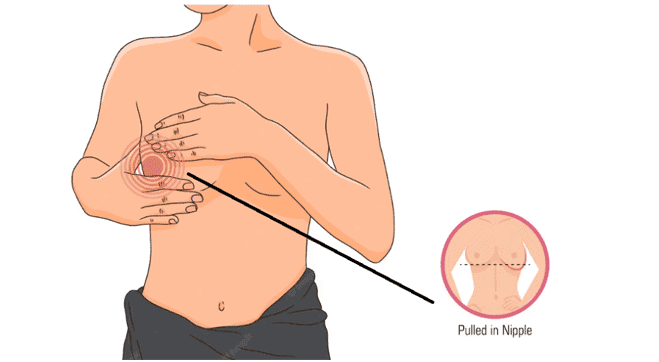
Nipple inversion (or inverted nipple) refers to a condition in which one or both nipples are retracted inward instead of pointing outward. This can be present from birth (congenital) or develop later in life (acquired). While nipple inversion is often harmless and simply a variation of normal anatomy, new or sudden inversion—especially on one side—can sometimes indicate an underlying medical condition.
Types of Nipple Inversion

Nipple inversion is typically categorized by severity:
- Grade 1 (Mild): The nipple can be pulled out easily and stays outward temporarily.
- Grade 2 (Moderate): The nipple can be pulled out but tends to retract quickly.
- Grade 3 (Severe): The nipple is severely retracted and cannot be pulled out.
Causes of Nipple Inversion
1. Congenital (Present at Birth)
- Some individuals are born with inverted nipples due to short milk ducts or fibrous tissue pulling the nipple inward.
- Usually not a cause for concern.
2. Acquired (Develops Later in Life)
- Often due to changes in the breast structure or underlying health issues.
Common causes include:
- Aging or tissue changes – Breast tissue loses elasticity with age.
- Duct ectasia – Widening and inflammation of the milk ducts, usually in older women.
- Breast infections or abscesses – Infections may cause scarring and duct damage.
- Breast cancer – A serious cause of sudden, one-sided nipple inversion.
- Breast trauma or surgery – Scarring or damage to ducts or connective tissue.
- Inflammatory conditions – Such as mastitis or Paget’s disease.
When to Be Concerned
Seek medical evaluation if you notice:
- New or sudden inversion, especially in one nipple
- Associated symptoms, such as:
- Breast lump
- Discharge (especially bloody)
- Skin changes (dimpling, redness, thickening)
- Pain or swelling
Diagnosis of Nipple Inversion
To determine the cause, your healthcare provider may perform:
- Physical examination
- Breast ultrasound – To look for lumps or duct changes
- Mammogram – Especially in women over 40 or with a new change
- MRI – In complex or unclear cases
- Biopsy – If a suspicious lump or other signs of cancer are found
Treatment of Nipple Inversion
Treatment depends on the cause and severity:
1. No Treatment (If Congenital or Mild)
- Many women with mild, lifelong inversion require no intervention unless breastfeeding is a concern.
2. Nipple Exercises or Suction Devices
- Gentle suction (e.g., using a breast pump or nipple corrector) can sometimes help pull the nipple outward.
- Best for mild to moderate cases.
3. Surgical Correction
- Options include minimally invasive techniques that release tethered ducts and restore nipple projection.
- Considered for cosmetic reasons or breastfeeding difficulties.
- Important to preserve milk ducts if future breastfeeding is desired.
4. Treat Underlying Cause
- Antibiotics for infection or abscess
- Cancer treatment (surgery, chemotherapy, etc.) if malignancy is diagnosed
Complications
- Breastfeeding difficulties – Inverted nipples can make latching difficult for infants.
- Psychological impact – May cause distress or self-consciousness.
- Delayed diagnosis – Sudden inversion may delay the identification of a serious underlying issue if ignored.