


What is Lentigo Maligna?
Lentigo maligna is a type of skin cancer that primarily affects the skin of the face, especially in older adults. It starts as a slow-growing, pigmented (dark) spot, often mistaken for a benign freckle or age spot. Lentigo maligna is considered a form of melanoma in situ, which means that it is confined to the outer layers of the skin and has not yet spread to deeper tissues. If left untreated, however, it can progress into an invasive melanoma.

Types of Lentigo Maligna?
Lentigo maligna is often categorized based on its growth pattern:
- Lentigo Maligna (in situ): This is the early stage of lentigo maligna, where the cancer cells are confined to the outermost layer of the skin (the epidermis). It has a good prognosis when diagnosed at this stage.
- Invasive Lentigo Maligna: If the cancer progresses and invades deeper layers of the skin, it becomes an invasive melanoma, which has a higher potential for metastasis and requires more aggressive treatment.
Causes of Lentigo Maligna?
Lentigo maligna is primarily caused by long-term sun exposure, especially in areas that are frequently exposed to sunlight, like the face. Other contributing factors include:
- Aging: It is more commonly seen in people over the age of 50, as the skin’s ability to repair sun damage decreases over time.
- UV Radiation: Chronic exposure to ultraviolet (UV) rays from the sun or tanning beds can damage skin cells, leading to the development of lentigo maligna.
- Fair Skin: People with fair skin, who are more prone to sunburns, are at a higher risk of developing lentigo maligna.
- Genetics: A family history of melanoma or other skin cancers may increase the risk of developing lentigo maligna.
Symptoms of Lentigo Maligna?
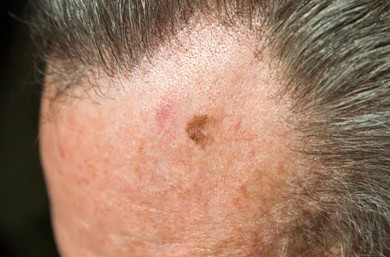
Lentigo maligna typically presents as a flat or slightly raised, irregularly shaped, dark brown to black spot on sun-damaged skin, usually on the face, especially around the nose, cheeks, and ears. Common signs include:
- A Slowly Growing Spot: It often starts as a small, flat, darkly pigmented spot, which gradually enlarges over time.
- Irregular Borders: The borders of the spot may be uneven or jagged, and the pigmentation may vary in color.
- Asymmetry: The lesion may not be symmetrical and may show different colors or shades.
- Surface Changes: The surface of the lesion may be smooth or scaly, and in more advanced stages, the area may become raised or develop crusting.
Diagnosis of Lentigo Maligna?
Diagnosis of lentigo maligna typically involves a thorough skin examination followed by biopsy to confirm the presence of cancer cells. Key diagnostic methods include:
- Skin Examination: A healthcare provider will examine the affected area closely, looking for suspicious spots or lesions with characteristics such as asymmetry, irregular borders, and varying pigmentation.
- Biopsy: A skin biopsy is essential for confirming the diagnosis. A small sample of the lesion is removed and examined under a microscope to check for cancer cells.
- Dermatoscopy: This non-invasive imaging technique is used to examine the skin lesion in greater detail to assess its characteristics and aid in diagnosis.
- Wide Local Excision: In some cases, a wide excision may be performed to remove a larger portion of the lesion, particularly when the lesion is large or has irregular edges.
Treatment and Management of Lentigo Maligna?
The main goal of treatment is to remove the cancerous cells before they spread to deeper layers of the skin. Treatment options may include:
- Surgical Excision: The most common treatment is the surgical removal of the lentigo maligna lesion, including a margin of healthy tissue around it. This ensures that the entire area of affected skin is removed.
- Mohs Micrographic Surgery: This precise form of surgery is particularly effective for lentigo maligna on the face, where it is important to preserve as much healthy tissue as possible. The surgeon removes the cancerous tissue layer by layer, examining each layer under a microscope until all cancer cells are removed.
- Radiation Therapy: In cases where surgery is not possible, or for larger or more difficult-to-remove lesions, radiation therapy may be used to target cancer cells.
- Topical Treatments: Some patients may benefit from topical treatments such as imiquimod, a cream that stimulates the immune system to fight cancer cells.
- Laser Therapy: In some cases, laser treatments may be used to remove the cancerous tissue, although this is less common.
Possible Complications of Lentigo Maligna?
If left untreated, lentigo maligna can develop into invasive melanoma, which can spread to other parts of the body. Other potential complications include:
- Cosmetic Concerns: Surgical removal of the lesion, especially from the face, can result in scarring or changes in skin appearance.
- Recurrence: If not completely excised, lentigo maligna may recur, requiring further treatment.
- Invasive Melanoma: If the lentigo maligna progresses to an invasive melanoma, it can metastasize to distant organs, which makes it much harder to treat.
Prevention of Lentigo Maligna?
While not all cases of lentigo maligna can be prevented, reducing the risk of developing the condition is possible through:
- Sun Protection: Regular use of sunscreen with a high SPF, wearing protective clothing, and seeking shade can help reduce exposure to UV radiation.
- Avoiding Tanning Beds: Artificial UV radiation from tanning beds should be avoided, as it increases the risk of skin cancer.
- Regular Skin Checks: Early detection through regular skin exams, either by a healthcare provider or self-exams, can help identify suspicious spots early, leading to more effective treatment.
- Healthy Skin Habits: Maintaining good skin care and avoiding excessive sun exposure, especially during peak UV hours, can lower the risk of developing lentigo maligna.
When to See a Doctor?
If you notice any new, changing, or unusual spots on your skin, particularly if they are darkly pigmented or have irregular borders, it is important to consult a healthcare provider. Additionally, seek medical advice if you experience:
- A new, growing, or changing mole or spot on your face or body.
- Changes in the appearance of existing freckles, moles, or age spots.
- Bleeding, crusting, or itching of any skin lesion.
- Any other signs of skin abnormalities.
